
What is silicone? Silicone is a family of synthetic polymers built around a backbone of alternating silicon and oxygen atoms, with organic groups attached to the silicon. By adjusting its molecular structure, additives and curing process, manufacturers can produce silicone as a fluid, gel, grease, flexible rubber or rigid resin.
Silicone is valued because selected formulations can remain flexible across a wide temperature range, resist weathering, provide electrical insulation and form reliable seals. These characteristics have made silicone important in food-contact products, medical devices, electronics, construction, automotive systems and industrial manufacturing.
Key Takeaways
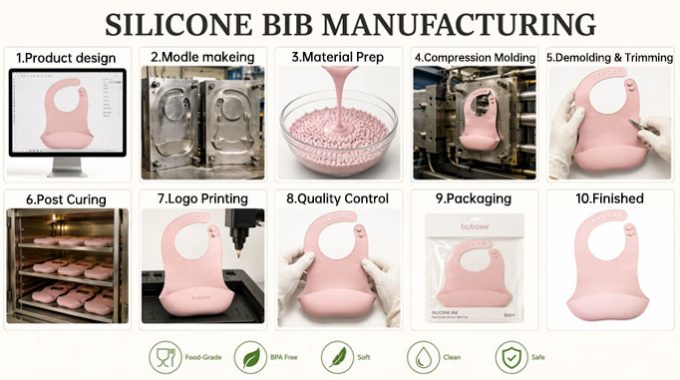
· Quality starts with clear specifications: Product requirements define function, design direction, and compliance goals.
· Design and tooling ensure consistency: Proper geometry and mold engineering improve comfort,durability, and production stability.
· Material control protects performance: Accurate silicone preparation and batch tracking maintain safety and color consistency.
· Process control defines final quality: Molding, curing, trimming, and post-curing determine strength, appearance, and reliability.
· Inspection builds customer confidence: Final checks on dimensions, odor, packaging, and traceability ensure shipment consistency.
However, “silicone” does not describe one universal material. Different formulations can have substantially different hardness, tensile strength, purity, heat resistance and regulatory status. Selecting the right silicone therefore requires more than checking whether a product is labeled “food grade,” “medical grade” or “heat resistant.”
Silicone at a Glance
The following points provide a quick overview:
- Silicone is a synthetic polymer, not the naturally occurring element silicon.
- Its main chain contains repeating silicon–oxygen, or siloxane, bonds.
- Polydimethylsiloxane, abbreviated as PDMS, is one of the most common silicone polymers.
- Silicone can be formulated as an oil, grease, gel, elastomer or resin.
- Silicone rubber is created when silicone polymer chains are crosslinked into an elastic three-dimensional network.
- Its performance depends on formulation, filler system, curing chemistry and manufacturing quality.
- Not every silicone product is automatically safe for food or medical use.
- Finished products must be tested for their specific conditions of use.
These three terms are frequently confused, but they refer to different materials.
| Term | Meaning | Common examples |
|---|---|---|
| Silicon | A chemical element with the symbol Si | Semiconductors, solar cells and alloys |
| Silica | Silicon dioxide, usually written as SiO₂ | Quartz, sand, glass and reinforcing fillers |
| Silicone | A family of synthetic polymers containing siloxane bonds | Sealants, tubing, molds, gaskets and cookware |
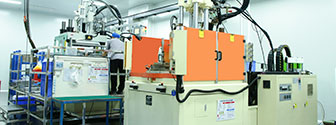
Liquid silicone rubber
Liquid silicone rubber, or LSR, is usually supplied as a two-part, pumpable material. The components are metered, mixed and injected into a heated mold.
LSR is suitable for high-volume production because it can support:
- Automated material feeding
- Short molding cycles
- Complex geometries
- Fine details
- Consistent repeatability
- Low-flash or flashless molding systems
Is Silicone the Same as Plastic?
Silicone and conventional plastic are both polymeric materials, but they have different molecular structures and processing behavior.
| Property | Silicone elastomer | Typical thermoplastic | Natural rubber |
|---|---|---|---|
| Main structure | Siloxane backbone with organic side groups | Primarily carbon-based polymer chains | Naturally derived polyisoprene |
| Processing | Usually cured or crosslinked | Usually melted and reshaped | Usually compounded and vulcanized |
| Elasticity | High in elastomer grades | Varies widely | High |
| Remelting | Normally cannot be simply remelted after curing | Often can be remelted | Cannot normally be remelted after vulcanization |
| Weather resistance | Often good | Polymer-dependent | Often needs protection |
| Gas permeability | Relatively high in many grades | Polymer-dependent | Grade-dependent |
| Recycling availability | Limited | Varies by polymer and location | Limited |
FAQs
Do silicone bags have microplastics?
Silicone bags are not made from conventional thermoplastics such as polyethylene. A new, properly manufactured bag should not intentionally contain loose microplastic fragments. However, silicone is a synthetic polymer, and research on related silicone products shows that microscopic silicone particles may be released under certain heating, aging or abrasion conditions. Evidence specific to reusable silicone bags remains limited.
Do silicone bags release microplastics when heated?
It cannot be guaranteed that every silicone bag releases zero particles at every temperature. Research has found particle release from certain silicone products under steam or cooking-related test conditions. Only heat a bag when the finished product is explicitly approved and tested for that method and temperature.
Do silicone bags leach chemicals?
Some silicone food-contact products can release low-molecular-weight siloxanes or other residual substances. Migration depends on formulation, curing, temperature, contact time and food type. This is why finished-product migration testing is important.
Is platinum-cured silicone completely safe?
Platinum curing is often preferred for high-quality food-contact silicone, but it is not an automatic guarantee of zero residues or zero migration. The finished product still needs appropriate formulation control, post-curing and compliance testing.
Are silicone bags safer than disposable plastic bags?
Silicone bags are typically more durable and reusable, which can reduce reliance on disposable bags. However, “safer” depends on product quality and usage. Silicone should not be described as completely inert or particle-free without supporting evidence.
When should I replace a silicone bag?
Replace it if you notice cuts, cracks, thinning, tackiness, permanent deformation, a damaged seal or a persistent unexplained odor. A bag does not need to be leaking before replacement becomes appropriate.
Are silicone bags environmentally friendly?
They can reduce waste when reused many times, but silicone is not usually biodegradable and is not accepted by many curbside recycling programs. “Reusable” and “durable” are more accurate descriptions than “zero-waste.”
What documentation should a silicone bag supplier provide?
Buyers should request finished-product test reports showing the applicable standard, product identity, tested color, food simulants, temperature, contact time and migration results. Material certificates and general marketing claims are not enough.